Items 1-5, as provided by Cracked. I prefer not to smack my forehead on a regular basis.
Which is not to say that independent comics are a field of posies through which people of all genders, races, and sexualities skip hand-in-hand (and possibly stop to buy the world a Coke). Why, David Sim, writer of Cerebus the Aardvark and winner of the 1994 Eisner for Best Graphic Album, has repeatedly espoused the view that a "feminist/homosexualist axis" is leading to the downfall of America, that men are superior creative "lights," and women are inferior un-creative "voids" that leech off the men and steal their light until they are completely emasculated, i.e. gay.
In 1996, a year after Sim wrote the essay "Reads" that basically claimed women have no souls, the Comic Book Legal Defense Fund gave him a "Defender of Liberty" award. Defend us, oh Sim, from the soulless ladies and gay men.
Saturday, May 8, 2010

Wednesday, May 5, 2010

Tuesday, May 4, 2010
Reading: Transmetropolitan (****/****)
Title: Transmetropolitan
Writer: Warren Ellis
Artist: Darick Robertson
Letterer: Clem Robins
I figure I should start a ratings system for these things. Four stars (****) is the highest, zero (-) is the lowest.
I'm also going to break my own rule here and post about a series before finishing all current issues. Transmetropolitan finished its run in 2002, and the rest of the series is waiting for me at the library; but I find that I just cannot contain myself. I want to leap onto tall buildings and hold this book up to the sky like Moses. I want to accost random people on the street and force them to read its pages. I want to get a three-eyed smiley face tattooed on my butt.
In case you haven't picked up on it yet, I really, really, really like this series.
I think a fair chunk of that adoration springs from a childhood spent reading The Hitchhiker's Guide to the Galaxy. The two works share a wry, cynical view of the world tempered by a weary kind of love; mankind, they seem to say, would be a wonderful thing if we weren't such a bunch of apes.
The protagonist of Transmetropolitan is Spider Jerusalem, a futuristic journalist who looks and acts like Hunter S. Thompson by way of Ford Prefect. He lives in a cluttered, filthy metropolis that's over-populated, over-stimulated, and under-informed. Jerusalem aims to fix the last of those problems with biting commentary that, surprise surprise, could just as easily be aimed at our current version of America.
Dystopian narratives are a dime a dozen, but writer Warren Ellis really put the work into this one and it shows. At first glance it's an imaginative playground, fun but harmless, until Ellis starts to pick it apart in his newspaper columns, examining each piece of the puzzle until we can trace its roots back to our own social triumphs and failures.
As our tour guide, Jerusalem is a misanthrope full of cigarette smoke, drugs, and cheap coffee who nonetheless is one of the last kind souls around. Driven to find "The Truth," he often champions the weak, the poor, those who this society (and ours) has neither the time nor the inclination to care about. No one is safe from Jerusalem's barbs (the name is obviously meant to evoke some kind of religious prophet, a situation that Jerusalem would probably both hate and love). He despises abusive authority figures most of all, and police brutality is a common thread, as is the incompetence or outright evil of our political leaders. Much of the main plot is driven by Spider Jerusalem's public duels with presidential candidate The Smiler. Jerusalem amasses enemies like a figurine collector, each more treasured than the last; but fate demands that sooner or later, it'll catch up to him.
Transmetropolitan is beautifully, wonderfully, refreshingly free of some modern prejudices. When a (beautiful, professional, Asian) woman turns down Jerusalem's advances by explaining that she's a lesbian, Jerusalem's only response is a rueful, "Oh, well," then some self-abuse of his dick (and not the way you think). As others have noted, Ellis is -- be still my heart -- a well-respected gay-positive figure in the world of comic books, and it shows in his work. (Apparently Ellis also created a gay superhero couple, Midnighter and Apollo. I've never been that big on superheros -- generally BECAUSE I knew there would be few queer- or female-positive storylines to be had in that line of comics -- but I'm gonna have to check it out.) If racism, homophobia, and sexism were bullets, Ellis would be like Neo in the Matrix, bending and twisting to dodge those motherfuckers. If any of them have scored a hit yet, I haven't noticed.
Nothing is done casually in Transmetropolitan. Everything has meaning, even (especially) the acts of violence that Ellis uses sparingly and gives actual weight to. I read thought in every single panel of every single page, and that is a rare thing indeed.
My absolute favorite parts of the series, though, okay, the things that have me all gleeful: Channon Yarrow and Yelena Rossini, the two assistants that Spider's newspaper provides for him. Admittedly, Channon's introduction is as a stripper and Yelena's is as a monosyllabic sourpuss; but we go on to discover that Channon was stripping her way through journalism school and is also a physical badass, and Yelena is just as whip-sharp as Spider Jerusalem. They both start out hating him, but come around to being his only loyal allies, while still having their own lives and goals. And best of all, they're shown to be friends with each other, frequenting male strip clubs, laughing as they run through the rain, and beating the shit out of small-time journos who try to stiff them out of payment for an interview with Jerusalem. Individually they are great, refreshing female characters; together, they are awesomeness personified.
I've read through the first four collected volumes and the first issue of volume five. I almost don't want to read further; I want to always imagine Spider, Channon, and Yelena cooped up in their apartment together, Spider spitting his prophet-poison from high above the city while Yelena rolls her eyes and Channon beats the crap out of some assassin out to get Spider.
Don't kill my dreams, man.
Listening to: "Souretsu" by Shiina Ringo
Reading: Volume 5 of this
Playing: "When the Levees Break" by Zep
Writer: Warren Ellis
Artist: Darick Robertson
Letterer: Clem Robins
I figure I should start a ratings system for these things. Four stars (****) is the highest, zero (-) is the lowest.
I'm also going to break my own rule here and post about a series before finishing all current issues. Transmetropolitan finished its run in 2002, and the rest of the series is waiting for me at the library; but I find that I just cannot contain myself. I want to leap onto tall buildings and hold this book up to the sky like Moses. I want to accost random people on the street and force them to read its pages. I want to get a three-eyed smiley face tattooed on my butt.
In case you haven't picked up on it yet, I really, really, really like this series.
I think a fair chunk of that adoration springs from a childhood spent reading The Hitchhiker's Guide to the Galaxy. The two works share a wry, cynical view of the world tempered by a weary kind of love; mankind, they seem to say, would be a wonderful thing if we weren't such a bunch of apes.
The protagonist of Transmetropolitan is Spider Jerusalem, a futuristic journalist who looks and acts like Hunter S. Thompson by way of Ford Prefect. He lives in a cluttered, filthy metropolis that's over-populated, over-stimulated, and under-informed. Jerusalem aims to fix the last of those problems with biting commentary that, surprise surprise, could just as easily be aimed at our current version of America.
Dystopian narratives are a dime a dozen, but writer Warren Ellis really put the work into this one and it shows. At first glance it's an imaginative playground, fun but harmless, until Ellis starts to pick it apart in his newspaper columns, examining each piece of the puzzle until we can trace its roots back to our own social triumphs and failures.
As our tour guide, Jerusalem is a misanthrope full of cigarette smoke, drugs, and cheap coffee who nonetheless is one of the last kind souls around. Driven to find "The Truth," he often champions the weak, the poor, those who this society (and ours) has neither the time nor the inclination to care about. No one is safe from Jerusalem's barbs (the name is obviously meant to evoke some kind of religious prophet, a situation that Jerusalem would probably both hate and love). He despises abusive authority figures most of all, and police brutality is a common thread, as is the incompetence or outright evil of our political leaders. Much of the main plot is driven by Spider Jerusalem's public duels with presidential candidate The Smiler. Jerusalem amasses enemies like a figurine collector, each more treasured than the last; but fate demands that sooner or later, it'll catch up to him.
Transmetropolitan is beautifully, wonderfully, refreshingly free of some modern prejudices. When a (beautiful, professional, Asian) woman turns down Jerusalem's advances by explaining that she's a lesbian, Jerusalem's only response is a rueful, "Oh, well," then some self-abuse of his dick (and not the way you think). As others have noted, Ellis is -- be still my heart -- a well-respected gay-positive figure in the world of comic books, and it shows in his work. (Apparently Ellis also created a gay superhero couple, Midnighter and Apollo. I've never been that big on superheros -- generally BECAUSE I knew there would be few queer- or female-positive storylines to be had in that line of comics -- but I'm gonna have to check it out.) If racism, homophobia, and sexism were bullets, Ellis would be like Neo in the Matrix, bending and twisting to dodge those motherfuckers. If any of them have scored a hit yet, I haven't noticed.
Nothing is done casually in Transmetropolitan. Everything has meaning, even (especially) the acts of violence that Ellis uses sparingly and gives actual weight to. I read thought in every single panel of every single page, and that is a rare thing indeed.
My absolute favorite parts of the series, though, okay, the things that have me all gleeful: Channon Yarrow and Yelena Rossini, the two assistants that Spider's newspaper provides for him. Admittedly, Channon's introduction is as a stripper and Yelena's is as a monosyllabic sourpuss; but we go on to discover that Channon was stripping her way through journalism school and is also a physical badass, and Yelena is just as whip-sharp as Spider Jerusalem. They both start out hating him, but come around to being his only loyal allies, while still having their own lives and goals. And best of all, they're shown to be friends with each other, frequenting male strip clubs, laughing as they run through the rain, and beating the shit out of small-time journos who try to stiff them out of payment for an interview with Jerusalem. Individually they are great, refreshing female characters; together, they are awesomeness personified.
I've read through the first four collected volumes and the first issue of volume five. I almost don't want to read further; I want to always imagine Spider, Channon, and Yelena cooped up in their apartment together, Spider spitting his prophet-poison from high above the city while Yelena rolls her eyes and Channon beats the crap out of some assassin out to get Spider.
Don't kill my dreams, man.
Listening to: "Souretsu" by Shiina Ringo
Reading: Volume 5 of this
Playing: "When the Levees Break" by Zep
Sunday, May 2, 2010
ATGTSTZA: Chapter 2
I'm happy to announce the arrival of Chapter 2 of A Teenager's Guide to Surviving the Zombie Apocalypse. In this 13-page chapter, The Miracle family ponder recent events, and Max meets the girl of his dreams. Too bad she seems to hate everything in the entire world, including him. Oh, and there's that decapitated zombie running around. Good times!
This chapter was illustrated by the lovely Ms. Alyssa Gnall, badass zombie killah and all-around good sport.
Go check it out! And do tell me how y'all like using the SmackJeeves site. Pros? Cons? Preferences?
This chapter was illustrated by the lovely Ms. Alyssa Gnall, badass zombie killah and all-around good sport.
Go check it out! And do tell me how y'all like using the SmackJeeves site. Pros? Cons? Preferences?
Monday, April 26, 2010
Reading: The Umbrella Academy (***/****)
Title: The Umbrella Academy, Apocalypse Suite & Dallas
Writer: Gerard Way
Artist: Gabriel Ba
Letterist: Nate Piekos
Colors: Dave Stewart
From the very first panel of "The Umbrella Academy: Apocalypse Suite" -- in which a hulking pro wrestler delivers a flying elbow slam to his opponent...a giant squid -- it's clear that we're in for something different. TUA was the toast of the 2008 Eisners, where Dave Stewart won Best Colorist (for his work on this and other Dark Horse properties), James Jean won for his cover art (on this and Fables), and Way and Ba won the coveted Best Limited Series award.
I can't remember the last time I saw a comic so gleefully leap into the realm of WTF. Just when you think you've got a handle on the rules and reality of this alternate Earth, Way flips you the bird and goes skipping off among the treetops of insanity like one of those Crouching Tiger, Hidden Dragon weirdos. Real-world events such as Vietnam are referenced, but with the addendum that the Viet Cong were a bunch of vampires. (A slightly sketchy choice; more on that later.) I will confess that I am a complete sucker for alternate history fiction, but the series has much more to recommend it.
Underneath all the craziness, TUA is a deconstruction of the superhero mythology with its roots firmly dug into Watchmen: a group of extraordinary children of mysterious origins are groomed to be a superhero team by a neglectful, meglomaniacal entrepeneur and grow up to be a group of very screwed up adults, each with their own issues and nueroses. Their powers are as unusual as the world they inhabit. My two favorites, Allison ne Rumor and Klaus ne Seance, battle villians by lying and communicating with the dead, respectively. Their adversaries range from a rampaging Lincoln monument to a past/future version of themselves. (It's a long story.)
Occasionally Way's flights of fancy trip and crash. 90% of Dallas is excellently written, but the cutaways to a random playboy, John Perseus, stick out like an inexplicable thumb. They have no effect on the rest of the story; apparently they set up a future plotline in series 3, but if so, there's no cliffhanger for it and thus Perseus is just kinda hanging out in the wind. (Bleah, bad image, sorry.) But when TUA works, it's all kinds of nummy, crazy fun.
I would give the series an unadultered recommedation -- were it not for one thing. Well, two things, but Way seems aware of his issues vis-a-vis female characters, and that was partly fixed at the end of Dallas. A bigger, more problematic issue looms in the very setup of the series: 43 women in random locations around the world give birth at the same time, Professor Hargreeves travels far and wide to gather up as many of the children as possible...
Aaaaaaaaand they're all white.
At least, all of the ones that Hargreeves found are white. It's not that non-white people don't exist in the UA world, it's just that none of them get to be main characters. No, instead they get to be vampires, i.e. inhuman and bloodthirsty.
Mr. Way, I raise a skeptical Spock eyebrow at you. *Spocks out*
Does it pass the Bechdel test: Yes
Writer: Gerard Way
Artist: Gabriel Ba
Letterist: Nate Piekos
Colors: Dave Stewart
From the very first panel of "The Umbrella Academy: Apocalypse Suite" -- in which a hulking pro wrestler delivers a flying elbow slam to his opponent...a giant squid -- it's clear that we're in for something different. TUA was the toast of the 2008 Eisners, where Dave Stewart won Best Colorist (for his work on this and other Dark Horse properties), James Jean won for his cover art (on this and Fables), and Way and Ba won the coveted Best Limited Series award.
I can't remember the last time I saw a comic so gleefully leap into the realm of WTF. Just when you think you've got a handle on the rules and reality of this alternate Earth, Way flips you the bird and goes skipping off among the treetops of insanity like one of those Crouching Tiger, Hidden Dragon weirdos. Real-world events such as Vietnam are referenced, but with the addendum that the Viet Cong were a bunch of vampires. (A slightly sketchy choice; more on that later.) I will confess that I am a complete sucker for alternate history fiction, but the series has much more to recommend it.
Underneath all the craziness, TUA is a deconstruction of the superhero mythology with its roots firmly dug into Watchmen: a group of extraordinary children of mysterious origins are groomed to be a superhero team by a neglectful, meglomaniacal entrepeneur and grow up to be a group of very screwed up adults, each with their own issues and nueroses. Their powers are as unusual as the world they inhabit. My two favorites, Allison ne Rumor and Klaus ne Seance, battle villians by lying and communicating with the dead, respectively. Their adversaries range from a rampaging Lincoln monument to a past/future version of themselves. (It's a long story.)
Occasionally Way's flights of fancy trip and crash. 90% of Dallas is excellently written, but the cutaways to a random playboy, John Perseus, stick out like an inexplicable thumb. They have no effect on the rest of the story; apparently they set up a future plotline in series 3, but if so, there's no cliffhanger for it and thus Perseus is just kinda hanging out in the wind. (Bleah, bad image, sorry.) But when TUA works, it's all kinds of nummy, crazy fun.
I would give the series an unadultered recommedation -- were it not for one thing. Well, two things, but Way seems aware of his issues vis-a-vis female characters, and that was partly fixed at the end of Dallas. A bigger, more problematic issue looms in the very setup of the series: 43 women in random locations around the world give birth at the same time, Professor Hargreeves travels far and wide to gather up as many of the children as possible...
Aaaaaaaaand they're all white.
At least, all of the ones that Hargreeves found are white. It's not that non-white people don't exist in the UA world, it's just that none of them get to be main characters. No, instead they get to be vampires, i.e. inhuman and bloodthirsty.
Mr. Way, I raise a skeptical Spock eyebrow at you. *Spocks out*
Does it pass the Bechdel test: Yes
Saturday, April 24, 2010
Max & Kara: ~This magic moment~
This makes me grin so hard:

This isn't from Chapter 2 per se, but Alyssa, the artist who's taken over drawing Chapter 2, did this as an extra little bit. It's Max and Kara, eyeing each other as nervous, awkward teenagers are wont to do. ♥___♥ Hearts in my eyes, people! They are so precious. I love Kara's little facepaint.

This isn't from Chapter 2 per se, but Alyssa, the artist who's taken over drawing Chapter 2, did this as an extra little bit. It's Max and Kara, eyeing each other as nervous, awkward teenagers are wont to do. ♥___♥ Hearts in my eyes, people! They are so precious. I love Kara's little facepaint.
Friday, April 16, 2010
Comics: Preacher (*/****)
Title: Preacher
Writer: Garth Ennis
Artist: Steve Dillon
Letterer: Clem Robins
Colorists: Matt Hollingsworth and Pamela Rambo
I have spent the last three weeks plodding through the Preacher series - or, well, I spent one week plodding through a few issues, one week skimming the rest, and the last one trying to decide what the hell I was going to say about it.
After much thought, my feelings can be summarized as such: no seriously, can we just pack all the main characters (and most of the minor ones, too) into a crate and drop a nuke on them? Never have I ever read so much of a story in which I not only didn't care about the supposed protagonists, I came to actively dislike them as the story progressed. The only one of 'em worth a damn was Cassidy, and look how that turned out.
The technical specs can't be blamed: Dillon occasionally wrestles with the dreaded Same Face Syndrome -- he's overly fond of furrowed brows, all of the lawmen have the same squinty-eyed sneer, and Lori is Tulip with one eye -- but other than that his work is solid. Letterist Clem Robins was excellent, and the comic looks pretty damn gorgeous. The story and the characters are another matter.
The first time we meet Reverend Jesse Custer, he's drunkenly staggering through town, insulting members of his flock before collapsing in a pool of his own vomit. Throughout the series he's shown to be extremely violent, breaking limbs and permanently disfiguring people with little provocation. Early on, Custer gets possessed by an angel/demon hybrid called Genesis; when he questions an errant angel about why, the angel admits that they don't know anything because God has left His post in Heaven. Which...causes Jesse to basically declare war on God. And that's our hero.
Now, don't get me wrong, I'm all for an anti-hero marathon of epic proportions. It's just that Ennis then inserts The Hero into the narrative: John Wayne, the anti-anti-hero, appears as Jesse's spiritual advisor. It's unclear whether he's a stand-in for the spirit possessing Jesse, a representation of Jesse's murdered father, or some other kind of manifestation. I think we're supposed to look at Jesse as a new John Wayne -- he even rides off into the sunset with a girl on a horse at the end -- but the juxtaposition between them has the opposite effect. Jesse's swift decision to blame God makes very little sense at that point in the narrative, and doesn't until much, much later when his super-religious, batshit-crazy family appears. And then it comes across as the psychopathic flailings of an abuse-twisted soul, acting out against his abusers and their belief system.
Of course then the series goes on to justify Jesse's vendetta against God, turning the Almighty into a love-needy kid with an ant farm, poking us tunnels or burning us with a magnifying glass at His whim. Which, again: could have been a compelling and interesting story. But by then, Ennis had lost me. Through his possession Jesse winds up with powers that rival God's, and he wields them just as haphazardly, with as little regard for consequences.
If this is our alternative to both God and The Duke, then we're screwed.
I do give Preacher credit for a few things, most notably the character of Tulip O'Hare, Jesse's gun-toting girlfriend. Tulip is a crack shot, can hold her own in a fight, and rails against Jesse's old-fashioned chivalry, particularly when he tries to leave her behind for her own protection. Tulip has a startling amount of agency for a female comic book character, let alone one in a psuedo-Western, and the series never punishes her for her independence, abilities, or her healthy sexuality. Jesse even refrains from the temptation of using his mind-whammy abilities for sexual favors from Tulip, a moral stance that I commend Ennis for taking; tragically few male writers would have recognized that as outright rape. Preacher has several other strong female characters and manages to pass the Bechdel Test on occasion. The series also takes on racism, particularly in the "Salvation" arc, and manages to condemn it without coming across as, ahem, preachy. It acknowledges that there are degrees to prejudice, while never excusing it in any form. Deputy Cindy Dagget, Jesse's ally in Salvation, looks a bit like Grace Jones and is full boss; I woulda read a whole series based on her.
And what did I get at the end of all that slogging? What slam-bang ending awaited my long-suffering readership? A completely pointless climax and a quite-literal deus ex machina. Jessie's possession by Genesis amounts to exactly nothing, he sacrifices himself but is immediately revived for a happy ending, and God is killed because -- oh, who knows. After all that sound and fury, Preacher had nothing even resembling a point. I calmly and firmly set the book aside.
There's still a dent where it hit the wall.
The nine volumes sat on my living room floor for a week while I pondered how to qualify my distaste for a such a universally-acclaimed series, until my buddy Charles dropped by to visit. Prodding the pile of slick tradebacks with his foot, Friend Charles correctly picked up volume 1 based solely on the cover (so pat yourself on the back, cover artist Glenn Fabry) and started to read the first few pages. And dear readers, cleans the palatte like an ironic audio rendition. All of the angels (whom Friend Charles identified as James Maynard Keenan fans) suddenly had the twangy Southern accents while Jesse and his friends developed posh British dialects, complete with interjections of "I say!"
The reading left me in stitches, but it also helped me get a handle on what bugs me the most about the Preacher series: if it's meant to be a top-to-bottom examination of "America" (the idea, not the reality), then Ennis seems to believe, like Sarah Palin, that the True America is small-town and Southern - not those big-city intellectual Commie faggots. (Curious, as Ennis himself hails from Northern Ireland. I would speculate that underneath all the xenophobic Americana mystique is a critical satire of said mystique, but that's probably too complex a read for the material.) Perhaps this attitude was avante garde when Ennis wrote the series in the politically-correct, Clinton-era 90's; these days, though, the idea of ultra-violent vigilante Southern justice makes one's head spin with images of bloodthirsty Teabaggers.
Now obviously Ennis can't be held responsible for predicting where the culture wars would lead us in a post-boom, post-9/11, "post-racism" world. But the fact remains: 10 years after he completed the series, the American mystique ain't what it used to be, Pilgrim, and neither is Preacher.
Writer: Garth Ennis
Artist: Steve Dillon
Letterer: Clem Robins
Colorists: Matt Hollingsworth and Pamela Rambo
I have spent the last three weeks plodding through the Preacher series - or, well, I spent one week plodding through a few issues, one week skimming the rest, and the last one trying to decide what the hell I was going to say about it.
After much thought, my feelings can be summarized as such: no seriously, can we just pack all the main characters (and most of the minor ones, too) into a crate and drop a nuke on them? Never have I ever read so much of a story in which I not only didn't care about the supposed protagonists, I came to actively dislike them as the story progressed. The only one of 'em worth a damn was Cassidy, and look how that turned out.
The technical specs can't be blamed: Dillon occasionally wrestles with the dreaded Same Face Syndrome -- he's overly fond of furrowed brows, all of the lawmen have the same squinty-eyed sneer, and Lori is Tulip with one eye -- but other than that his work is solid. Letterist Clem Robins was excellent, and the comic looks pretty damn gorgeous. The story and the characters are another matter.
The first time we meet Reverend Jesse Custer, he's drunkenly staggering through town, insulting members of his flock before collapsing in a pool of his own vomit. Throughout the series he's shown to be extremely violent, breaking limbs and permanently disfiguring people with little provocation. Early on, Custer gets possessed by an angel/demon hybrid called Genesis; when he questions an errant angel about why, the angel admits that they don't know anything because God has left His post in Heaven. Which...causes Jesse to basically declare war on God. And that's our hero.
Now, don't get me wrong, I'm all for an anti-hero marathon of epic proportions. It's just that Ennis then inserts The Hero into the narrative: John Wayne, the anti-anti-hero, appears as Jesse's spiritual advisor. It's unclear whether he's a stand-in for the spirit possessing Jesse, a representation of Jesse's murdered father, or some other kind of manifestation. I think we're supposed to look at Jesse as a new John Wayne -- he even rides off into the sunset with a girl on a horse at the end -- but the juxtaposition between them has the opposite effect. Jesse's swift decision to blame God makes very little sense at that point in the narrative, and doesn't until much, much later when his super-religious, batshit-crazy family appears. And then it comes across as the psychopathic flailings of an abuse-twisted soul, acting out against his abusers and their belief system.
Of course then the series goes on to justify Jesse's vendetta against God, turning the Almighty into a love-needy kid with an ant farm, poking us tunnels or burning us with a magnifying glass at His whim. Which, again: could have been a compelling and interesting story. But by then, Ennis had lost me. Through his possession Jesse winds up with powers that rival God's, and he wields them just as haphazardly, with as little regard for consequences.
If this is our alternative to both God and The Duke, then we're screwed.
I do give Preacher credit for a few things, most notably the character of Tulip O'Hare, Jesse's gun-toting girlfriend. Tulip is a crack shot, can hold her own in a fight, and rails against Jesse's old-fashioned chivalry, particularly when he tries to leave her behind for her own protection. Tulip has a startling amount of agency for a female comic book character, let alone one in a psuedo-Western, and the series never punishes her for her independence, abilities, or her healthy sexuality. Jesse even refrains from the temptation of using his mind-whammy abilities for sexual favors from Tulip, a moral stance that I commend Ennis for taking; tragically few male writers would have recognized that as outright rape. Preacher has several other strong female characters and manages to pass the Bechdel Test on occasion. The series also takes on racism, particularly in the "Salvation" arc, and manages to condemn it without coming across as, ahem, preachy. It acknowledges that there are degrees to prejudice, while never excusing it in any form. Deputy Cindy Dagget, Jesse's ally in Salvation, looks a bit like Grace Jones and is full boss; I woulda read a whole series based on her.
I wish I could say that this precious bloom of progressive thought extends to all parts of the comic. Unfortunately, Ennis' slavvish devotion to the Western ideal of masculinity and to the good ole boy friendship between Jesse and Cassidy, an Irish vampire, translates into bountiful amounts of homophobia. "Faggots" abound; John Wayne even gets one in when Jesse's having a crisis of the soul. In one issue a tough-ass cop takes on New York City's toughest criminals with ruthless effeciency, until he figures out that he's a repressed homosexual. Then he quits the force, despite being well-respected and universally admired by his peers, because obviously faggots can't be cops.
Somewhere, John Cooper of the tv show Southland is rolling his eyes so hard and doesn't even know why.
Despite all my misgivings, I kept trying to slog through the series. I really shouldn't have -- just thinking about the pages of violence and gore leave me with a queasy stomach. And this is a girl who loves zombie movies. It's my firm belief, though, that violence should serve a purpose in a narrative; otherwise I might as well watch an autopsy video. Considered by some to be the bloodiest comic ever, the violence in Preacher is plentiful, lovingly detailed, and utterly ridiculous. Bullets blow massive holes in their targets, faces are cut off, and horses are cut in half with a band saw. Volume 4: Ancient History is literally page after page of gruesome killings. It was like reading the script for a three-hour long snuff film.And what did I get at the end of all that slogging? What slam-bang ending awaited my long-suffering readership? A completely pointless climax and a quite-literal deus ex machina. Jessie's possession by Genesis amounts to exactly nothing, he sacrifices himself but is immediately revived for a happy ending, and God is killed because -- oh, who knows. After all that sound and fury, Preacher had nothing even resembling a point. I calmly and firmly set the book aside.
There's still a dent where it hit the wall.
The nine volumes sat on my living room floor for a week while I pondered how to qualify my distaste for a such a universally-acclaimed series, until my buddy Charles dropped by to visit. Prodding the pile of slick tradebacks with his foot, Friend Charles correctly picked up volume 1 based solely on the cover (so pat yourself on the back, cover artist Glenn Fabry) and started to read the first few pages. And dear readers, cleans the palatte like an ironic audio rendition. All of the angels (whom Friend Charles identified as James Maynard Keenan fans) suddenly had the twangy Southern accents while Jesse and his friends developed posh British dialects, complete with interjections of "I say!"
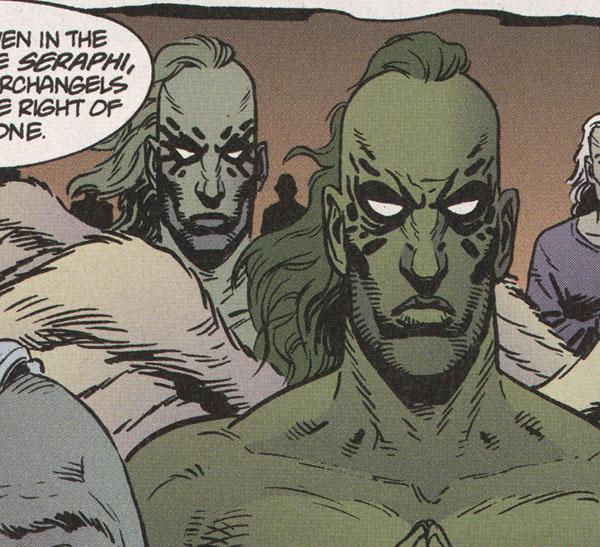
The reading left me in stitches, but it also helped me get a handle on what bugs me the most about the Preacher series: if it's meant to be a top-to-bottom examination of "America" (the idea, not the reality), then Ennis seems to believe, like Sarah Palin, that the True America is small-town and Southern - not those big-city intellectual Commie faggots. (Curious, as Ennis himself hails from Northern Ireland. I would speculate that underneath all the xenophobic Americana mystique is a critical satire of said mystique, but that's probably too complex a read for the material.) Perhaps this attitude was avante garde when Ennis wrote the series in the politically-correct, Clinton-era 90's; these days, though, the idea of ultra-violent vigilante Southern justice makes one's head spin with images of bloodthirsty Teabaggers.
Now obviously Ennis can't be held responsible for predicting where the culture wars would lead us in a post-boom, post-9/11, "post-racism" world. But the fact remains: 10 years after he completed the series, the American mystique ain't what it used to be, Pilgrim, and neither is Preacher.
Subscribe to:
Posts (Atom)